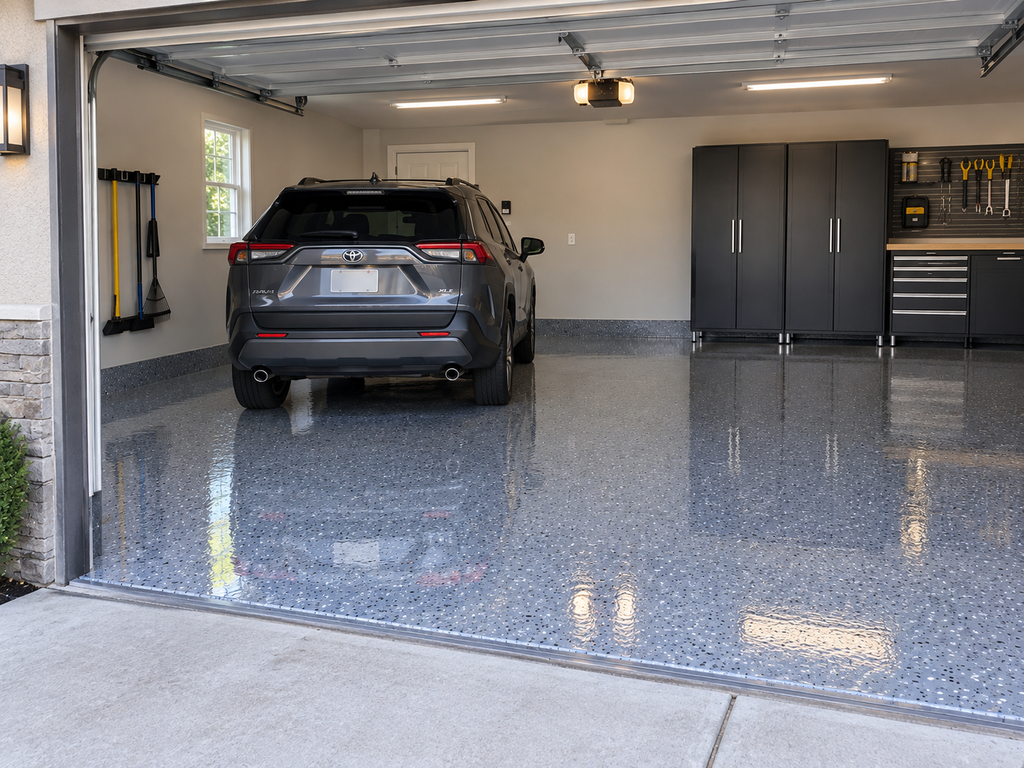
One day of work. A floor you stop apologizing for.
Most garage floors in [City] are doing a job nobody hired them for — soaking up oil, holding road salt against the concrete all winter, and chalking dust onto everything you own. We fix that in a single day with a ground-in, chip-broadcast coating system that bonds to the slab instead of sitting on top of it.
Why Garage Floors Fail
Bare concrete is porous. That’s not a flaw — it’s just what concrete is. But it means every drop of brake fluid, every gallon of snowmelt off your tires, and every bag of ice melt that gets tracked in goes into the slab, not on it. Freeze-thaw cycles do the rest. Water gets in, expands, and pops the surface off in dinner-plate flakes.
Then there’s the stuff people try first:
- Big-box epoxy kits. Roll-on, water-based, about 3 mils thick when it cures. They peel. Usually within a year, usually starting where you park your driver’s-side front tire.
- Concrete paint. Lasts one season if you’re lucky. It’s paint.
- Sealers. Fine for what they do, but they don’t hide staining, don’t build thickness, and don’t stop chipping.
The problem in every case is the same: nothing was done to the concrete before the coating went on. If the surface isn’t opened up mechanically, the coating has nothing to grab.
How We Actually Do It
We’re not faster because we cut steps. We’re faster because polyaspartic cures in hours instead of days, which means grind, patch, base, flake, and topcoat all happen between breakfast and dinner.
1. Moisture test and inspection. Before we quote anything, we check the slab for vapor drive. A garage over a high water table or without a vapor barrier under it will push moisture up through the concrete and delaminate a coating from underneath. If we find that, we tell you — and we either spec a moisture-mitigating primer or we tell you not to spend the money. We’d rather lose the job than warranty a failure.
2. Diamond grinding. We grind the entire slab with diamond-tooled machines running on HEPA vacuums. This is the step that separates a ten-year floor from a two-year one. It strips old coatings, sealers, and glue, and it opens the concrete’s pore structure to a profile the resin can key into. No acid etching. Acid etch is a shortcut that leaves residue behind and never gets the profile deep enough.
3. Repairs. Cracks get chased out, filled with a flexible polyurea, and re-ground flush. Pits and spalled areas get patched. Control joints get treated so they can still move without telegraphing a crack straight through your new floor.
4. Base coat and flake broadcast. The pigmented base goes down, and we hand-broadcast vinyl chip to full rejection — meaning we keep throwing flake until the floor won’t take any more. Partial broadcast is where you see those thin, patchy “confetti” floors. Full rejection is what gives you the even, granite-like look and the built-in slip texture.
5. Scrape, vacuum, and clear topcoat. Excess flake comes back up, and one or two coats of clear polyaspartic go over the top. That clear layer is what takes the abuse — UV, chemicals, hot tires, the corner of a dropped socket wrench.
You can walk on it that evening. Park on it in about 24 hours.
What You Get
Hot tire resistant. Summer tires come off the road at 150°F and sit on your floor. Cheap coatings soften and lift with the tread pattern still in them — installers call it hot tire pickup. Polyaspartic doesn’t thermoplastic like that.
Chemical resistant. Gas, oil, antifreeze, brake cleaner, battery acid, ice melt. Wipe it up when you notice it, not when you remember it.
UV stable. Leave the garage door open all summer and the floor doesn’t go yellow. Standard epoxy does. This is the single most common complaint we hear about floors somebody else installed.
Actually cleanable. A push broom and a mop. No more dust cloud every time you sweep, because there’s no more concrete surface to give one off.
Roughly 4x the thickness of a hardware store kit, and mechanically bonded rather than glued to a sealed surface.
Colors and Finishes
Most people pick a flake blend and never think about it again — which is the point. The chip does the heavy lifting visually: it hides dirt, breaks up sightlines, and camouflages the small imperfections every poured slab has.
- Full-chip blends — the standard. Domino, granite grays, tans, blues, blacks and whites.
- Quartz broadcast — heavier texture, brighter, common in workshops and home gyms.
- Solid color with a clear coat — clean and modern, shows more, best in a garage that stays a garage.
- Metallic — poured and manipulated for a marbled look. Gorgeous, more expensive, better suited to showrooms and finished spaces than daily-driver parking.
Bring us a sample board decision or let us bring the boards to you. We’ll put them on your actual slab in your actual light, which never looks like the photo on a website.